
Life Path Number 6: Personality, Love, Career, and Compatibility

Life path number 6 is one of the most recognizable patterns in numerological research. People who carry this number tend to anchor the communities around them — they’re the ones others call during a crisis, the ones who quietly organize what needs organizing, and the ones who feel most purposeful when they’re genuinely useful to someone they care about. Life path 6 meaning, across numerological traditions, centers on responsibility, harmony, and the particular satisfaction that comes from caring well for others.
In this article:
- What 6 Means
- Personality Traits
- Strengths and Weaknesses
- Love and Relationships
- Compatibility
- Career
- Famous People
- Numerology Year 6
- Tarot and Astrology
- Common Questions


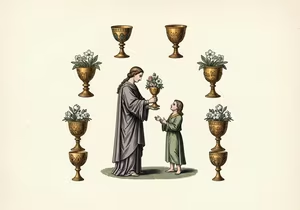

In my research on numerological patterns, I’ve found that no life path is more consistently described through its relationship to others. To calculate your own number: reduce your full birth date to a single digit or master number by summing the month, day, and year digits, then reducing again until you arrive at a number between 1 and 9 (or a master number: 11, 22, 33). If that final number is 6, this is your life path.
Life path 6 individuals aren’t trying to build something for themselves alone. Their orientation is outward, toward family, community, and the people they’ve chosen to be responsible for. This orientation is their greatest strength, and, when it becomes compulsive, their most persistent challenge.
What Does 6 Mean in Numerology
The number 6 in numerology sits between the restless 5 and the introspective 7, positioning it as the number of service and social responsibility. In numerological tradition, 6 is associated with Venus, the planet governing beauty, connection, and relational care. This explains why people with prominent 6 energy tend toward aesthetic sensitivity alongside their caregiving qualities.
Numerology 6 represents the archetype of the nurturer and the idealist. The number 6 also holds a distinction in mathematics: it’s the first “perfect number” (the sum of its divisors, 1+2+3, equals itself), and that sense of completeness echoes through the personality of those who carry this path.
In the Tarot, the numerological 6 corresponds to The Lovers, the sixth Major Arcana. The Lovers speaks not just to romantic partnership but to the deeper choices that define one’s values and commitments. This alignment reinforces what numerologists observe: life path 6 individuals make choices with their whole selves, and they feel the weight of those choices accordingly.
Core Personality Traits
Life path 6 personality is built around a consistent orientation toward others. I’ve observed several traits that appear reliably across this number.
Nurturing by default: People on this path don’t decide to be caregivers. It functions as their natural mode. They notice when someone in a room is struggling before that person has said a word. Friends and family consistently describe them as the person who always knows what someone needs.
Responsibility as identity: For life path 6, responsibility isn’t a burden but a self-concept. These individuals take commitments seriously, show up reliably, and feel genuine discomfort when they can’t meet an obligation. This makes them trusted partners in both personal and professional settings.
Aesthetically attuned: The Venus association shows clearly here. Those with this life path often have strong aesthetic instincts and opinions about design, harmony, and how spaces feel. They tend to create environments that others describe as welcoming, and many gravitate naturally toward creative fields.
Community-oriented: Where life path 1 builds independently and life path 3 performs for an audience, life path 6 builds for the group. Their satisfaction is social. They feel most themselves when their work improves something for people they care about.
Idealistic: Life path 6 individuals carry an internal image of how things should be, in relationships, in their homes, in their workplaces. This idealism drives their motivation but becomes a source of frustration when reality falls short of the inner standard.
Prone to over-responsibility: This shades into weakness. People with this path frequently take on more than their share, partly because they’re capable of it, and partly because delegating feels like abandonment.
Strengths and Weaknesses
Strengths
Life path 6 individuals bring several durable capacities to their relationships and communities.
Their empathy runs deep and tends to be accurate. It’s not just general warmth, but specific attunement to what another person is experiencing. In conflict situations, those with this path often function as natural mediators, finding language that both parties can accept.
Their reliability is a genuine contribution. In settings where follow-through is scarce, the person who does what they said they would do, on time and with care, stands out. Life path 6 individuals understand instinctively that trust is built through consistency.
Many who carry this number also have real artistic sensibility. I’ve seen this show up in cooking, interior design, music, visual art, and the care they bring to everyday environments. This aesthetic capacity often becomes professional skill. Designers, architects, and creative directors frequently share this path.
Finally, life path 6 individuals think in terms of care rather than transaction. They give without constantly calculating what they’ll receive, which makes them powerful forces in communities and organizations.
Weaknesses
The same orientation that makes life path 6 individuals so valuable also creates predictable blind spots.
Martyrdom is the shadow side of caregiving. These individuals sometimes keep score unconsciously. They give, and give, and give, and eventually feel unseen or unappreciated, without ever having articulated what they needed. Resentment accumulates quietly, often for longer than it should.
People-pleasing is a related pattern. Life path 6 individuals often struggle to disappoint others, which means they sometimes agree to things they can’t or shouldn’t do. Learning to decline without guilt tends to be a recurring developmental task for this path.
Self-neglect follows from over-giving. Those on this path frequently put their own physical and emotional needs last. The pattern is almost reflexive. Their own care is the thing they skip when time runs short.
Finally, idealism can slide toward control. When reality doesn’t match the internal image of how things should be, some life path 6 individuals respond by trying to manage other people’s choices. This tendency, when left unchecked, creates friction in close relationships.
Love and Relationships
Life path 6 love patterns are among the most consistent in numerological literature. These individuals are devoted partners who invest deeply. They remember anniversaries, they notice when something’s off with their partner, and they genuinely want to build something lasting together.
The challenge in life path 6 love is the asymmetry that can develop. People with this path give so readily that partners can unconsciously begin to take that generosity for granted. Over time, if reciprocity doesn’t match investment, resentment erodes what was once strong. In my reading of numerological case literature, this asymmetry pattern is the single most commonly documented challenge for life path 6 in long-term relationships.
Life path 6 individuals typically express love through acts of service and quality time. They create homes that feel warm and safe. They plan things and follow through. What they often need more practice with is articulating their own emotional needs directly, asking for what they want rather than hoping it will be noticed.
Romantic relationships that work well for life path 6 tend to involve partners who are emotionally present, expressive in their appreciation, and willing to share responsibility rather than simply receive care. The partnership functions best when both people act as co-caretakers rather than caretaker and recipient.
Compatibility
Life path 6 compatibility varies considerably depending on the other number in the pairing. Research across numerological traditions consistently identifies the same combinations as harmonious or challenging. What follows are the most commonly encountered pairings, based on how the core orientations of each number interact with the 6’s caregiving, stability-seeking nature.
Life Path 6 and Life Path 2
Life path 6 compatibility with life path 2 is often described as one of the more natural pairings. Both numbers are oriented toward harmony, connection, and partnership. I’ve found this combination well-documented across both Western and Vedic numerological traditions as a baseline-compatible match. The 2 brings sensitivity and diplomacy; the 6 brings structure and nurturing capacity. Together they tend to create stable, warm environments. The main risk is that both paths lean toward accommodation. Conflict can be avoided rather than addressed, which eventually costs something.
Life Path 6 and Life Path 9
Life path 6 and life path 9 share a humanitarian orientation, which creates strong common ground. The 9 operates at a broader social scale; the 6 works in closer, more personal circles. This complementarity can be powerful. In my research, I’ve observed this pairing described as one of the most purpose-aligned in numerological case studies. The 9 expands the 6’s sense of purpose, while the 6 grounds the 9’s sometimes diffuse idealism. Life path 6 compatibility with 9 often produces partnerships with a genuine sense of shared mission.
Life Path 6 and Life Path 3
Life path 3 brings creativity, humor, and social ease to a pairing with life path 6. The 6 provides stability and emotional depth; the 3 provides lightness and expressiveness. This tends to be an enjoyable combination, though those with the 6 may sometimes feel that the 3’s inconsistency conflicts with their need for reliability.
Life Path 6 and Life Path 5
Life path 6 compatibility with 5 tends to require conscious work. The 5 is oriented toward freedom, change, and stimulation, the opposites of what the 6 is trying to build. There can be strong initial attraction, but the long-term tension between the 5’s restlessness and the 6’s preference for stability is real. These pairs can thrive when both individuals have developed enough self-awareness to appreciate what the other brings without needing them to be different.
Life Path 6 and Life Path 1
Life Path 1 individuals are independent and driven, which can complement life path 6’s supportive nature, but only if the 1 recognizes and actively values that support. When the 1 takes the 6’s caregiving for granted, resentment builds. When the partnership is conscious and reciprocal, the 1’s ambition and the 6’s reliability form a highly functional combination.
Explore other life paths: Life Path 2 · Life Path 3


Career
Life path 6 career choices cluster predictably around service, care, and aesthetics. In my research, life path number 6 career patterns consistently point toward roles where people-orientation is a professional asset, not something to suppress. In my experience, people with this path aren’t well-suited to purely competitive environments where success requires indifference to others’ wellbeing. They do their best work in contexts where caregiving instincts are assets rather than liabilities.
Healthcare is a natural fit. Nursing, occupational therapy, family medicine, pediatrics, and social work attract people with this path in significant numbers. Counseling and therapy are common choices. The attunement and patience that define life path 6 translate directly into therapeutic effectiveness.
Education, particularly with younger children or in support roles, suits this orientation well. Interior design, landscape architecture, and hospitality draw on the aesthetic sensibility. Community organizing, nonprofit leadership, and restorative justice work align with the broader social responsibility that characterizes life path number 6 careers.
Settings that tend to frustrate those with this path include environments requiring sustained self-promotion, high-stakes competition, or emotional detachment. Life path 6 individuals in aggressive financial environments sometimes experience chronic discomfort with the prevailing culture, regardless of how technically skilled they are.
The career question for people with this path is rarely about capability. The more pressing question is whether the work allows meaningful contribution, rather than efficient task completion in isolation from people.
Famous People with Life Path 6
Several well-documented figures carry life path 6, and their biographies offer insight into how this number manifests across different fields. Calculating the path requires confirmed birth dates, which are noted below.
Michael Jackson (August 29, 1958): 8+2+9+1+9+5+8 = 42, then 4+2 = 6. Jackson’s sustained investment in creating environments of wonder reflects the 6’s drive to build something beautiful for others.
John Lennon (October 9, 1940): 1+0+9+1+9+4+0 = 24, then 2+4 = 6. Lennon’s work was consistently oriented toward collective healing and social responsibility, even when his personal life was contradictory. That tension between ideal and reality is characteristic of life path 6.
Albert Einstein (March 14, 1879): 3+1+4+1+8+7+9 = 33, a master number that reduces to 6. Einstein described his primary motivation as understanding the universe’s structure in service of human life, a quintessentially 6 orientation.
Eleanor Roosevelt (October 11, 1884): 1+0+1+1+1+8+8+4 = 24, then 6. Roosevelt transformed personal experience of neglect into sustained public caregiving. It’s one of the more striking expressions of this path’s developmental arc.
Bruce Willis (March 19, 1955): 3+1+9+1+9+5+5 = 33, then 6. Willis has spoken extensively about family as the central organizing principle of his identity.
Galileo Galilei (February 15, 1564): 2+1+5+1+5+6+4 = 24, then 6. Galileo’s dedication to making the cosmos comprehensible for others fits the pattern. People with this path don’t hoard knowledge or capability — they want to share it.
Numerology Year 6
People searching for “numerology year 6” or “6 year in numerology” are typically asking about the personal year cycle, which is distinct from the life path. A personal year 6 occurs when your personal year number, calculated from your birth month and day added to the current calendar year, reduces to 6.
The 6 year numerology cycle tends to bring themes of responsibility, home, relationships, and service to the foreground. It’s typically a year when family demands intensify, domestic decisions require attention, or a caregiving role becomes more central than usual. Numerology year 6 is associated with deepening commitments, improving living environments, and clarifying what and whom you’re genuinely responsible for.
For people with life path 6, a personal year 6 can feel both familiar and demanding. The themes of the year align so closely with their natural orientation that there’s often less respite from responsibility than in other years. The practical advice for life path 6 people moving through a 6 year is the same as always: ensure the caregiving flows in both directions.
Life Path 6 in Tarot and Astrology
The numerological 6 connects directly to The Lovers tarot card, the sixth Major Arcana. The Lovers speaks to choice, values, and the bonds that define a life. When this card appears in a reading for someone with life path 6, it often amplifies the theme of choosing consciously rather than simply drifting into obligations.
In astrology, the sixth house, associated with Virgo, governs service, health, and daily work. People with life path 6 often describe a compulsion toward useful work that mirrors the Virgo sixth-house archetype closely. The Venus rulership of the 6 also connects to Taurus and Libra, signs known for their appreciation of beauty, stability, and relational harmony.
For those working with crystals alongside numerological practice, amethyst is traditionally associated with clarity, calm, and protective energy. These qualities can help people with this path maintain healthy limits around their caregiving without withdrawing it entirely.
Common Questions About Life Path 6
What is the life path number 6 meaning in numerology?
Life path 6 meaning centers on responsibility, nurturing, and service. Individuals with this number are oriented toward caring for others, building harmonious environments, and contributing to community. The number 6 in numerology has been associated with Venus and the concept of harmony since the Pythagorean tradition. Its status as the first perfect number in mathematics also connects to the 6’s drive toward completeness and care.
What careers suit life path number 6?
Life path number 6 careers tend to cluster in healthcare, counseling, education, social work, design, and community-oriented fields. These individuals do their best work in environments where care and contribution are valued over pure competition. Specific roles that frequently attract people with this path include nursing, family therapy, teaching, interior design, and nonprofit leadership.
Who is life path 6 compatible with in numerology?
Life path 6 compatibility is generally strongest with life paths 2 and 9, which share the 6’s orientation toward harmony and meaningful contribution. Life path 3 also pairs well, bringing creative energy to the 6’s stability. Pairings with life path 5 tend to require more conscious work, since the 5’s restlessness conflicts with the 6’s preference for structure and reliability.
What are the main weaknesses of life path number 6?
The primary challenges include a tendency toward martyrdom, giving without asking for reciprocity, difficulty declining requests from others, self-neglect, and an idealism that can become controlling when reality doesn’t match expectations. Most developmental work for those with life path 6 involves learning to extend the same quality of care toward themselves that they give to others.
What does numerology year 6 mean, and how is it different from life path 6?
A personal year 6 in numerology is a temporary cycle based on the current calendar year combined with your birth date. It brings themes of home, family, and service to the foreground for that year. Life path 6, by contrast, reflects a lifelong orientation present from birth. The two can reinforce each other: someone with life path 6 moving through a personal year 6 often experiences an especially concentrated period of caregiving demands and relational decisions.

