
Sun in Astrology: Meaning, Influence, and Your Birth Chart

Sun in astrology holds a position unlike any other body in the birth chart. I’ve studied solar placements for over forty years, and it remains the center of identity, the animating force behind conscious self-expression, and the orientation of one’s deepest purpose. Most people know their sun sign — the zodiac position of the sun at birth — yet the full picture of what the sun in astrology means extends well beyond personality typing into mythology, medical tradition, and centuries of chart interpretation.
In this article:
- Mythology and Symbolism
- Sun Meaning
- The Zodiac Signs
- The Houses
- Does It Retrograde?
- Connections Across Domains
- Common Questions

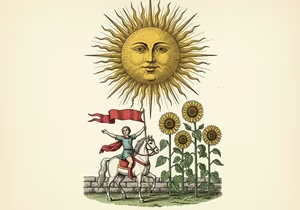

In the birth chart, the sun completes one full zodiac cycle each year, spending roughly thirty days in each sign. Sun in astrology represents the sign it occupied at the moment of birth. This placement, combined with the house the sun occupies, describes not just who a person is but how that person expresses the most conscious layer of self to the world.
The sun rules Leo, is exalted in Aries, and is in its fall in Libra. These dignities tell practitioners how freely solar principles flow in each sign. Sun in astrology meaning circles around three themes: identity, vitality, and life direction. I’ve found that students of astrology who understand the sun’s role clearly tend to read every other chart factor more accurately, because everything else orbits around solar themes.
Mythology and Symbolism of the Sun
Across cultures, the sun occupied the position of supreme luminary, associated with gods of order, governance, and conscious awareness. In Greek tradition, Helios drove his chariot across the sky each day, making the visible world possible. The Roman Sol Invictus, the unconquered sun, became central to late imperial religion and connected the sun to kingship and indestructibility.
In Vedic tradition, Surya represents the soul (atman): the eternal witnessing self that animates experience without being consumed by it. Egyptian Ra, Mesopotamian Shamash, and Norse Sol each carried similar associations. The sun’s recurring theme across traditions isn’t warmth or growth alone. It’s the force that makes reality legible, that bestows authority, and that sustains conscious life.
The astrological symbol of the sun is a circle with a dot at its center. Traditional interpreters read this image as the point of actualized consciousness (the dot) existing within the field of infinite potential (the circumference). The sun’s metal is gold. Its day is Sunday. Its number in most numerological systems is 1, reflecting the principles of self-origination and leadership.
As a luminary rather than a planet in astronomical terms, the sun occupies a category above the other chart factors. It’s a day luminary, thriving in direct expression, visibility, and authority structures.
Sun Meaning in Astrology
Sun in astrology meaning extends across several interconnected themes that I’ve seen practitioners return to across two millennia of recorded interpretation.
Identity and self-expression. The sun points toward the version of self a person is actively becoming. It’s not the habitual past (that’s the moon’s domain) nor the projected social mask (that’s the Ascendant’s territory), but the core of present, willed identity. People with prominent suns — in angular houses, in Leo, or with strong aspects to personal planets — typically display clear, recognizable self-concepts and respond strongly when that identity is challenged.
Vitality and physical constitution. Traditional medical astrology associated the sun with the heart, the spine, and overall vitality. Sun in astrology chart interpretation includes reading how much “solar fuel” a person has available: how easily they recover, sustain effort, and project life force. Challenging sun aspects, particularly hard contacts to Saturn or Neptune, often correlate with what I’d describe as a more complicated relationship to energy and health over time.
Relationship to authority and the father. In my experience, the sun in astrology represents the principle of authority in both personal and institutional dimensions. Traditional practice connected the sun to the father or male authority figures in early life. The sun’s aspects describe how a person internalizes, accepts, rebels against, or seeks to become authority itself.
Conscious life purpose. Unlike the North Node, which describes karmic direction, the sun describes the current-life orientation of the conscious self: what one is here to express, build, and be known for. Sun in astrology symbol — the point within the circle — captures this: something specific and bounded emerging from an unlimited field.
The sun rules Leo as its natural domicile, and wherever the sun falls in a chart, it carries Leo’s hunger for recognition, creative expression, and the desire to be genuinely seen.
Sun in the Zodiac Signs
Sun in Aries
Sun in Aries operates at its most direct. I’ve noticed in chart after chart that Aries is the sun’s exaltation sign, meaning solar self-assertion and identity-formation manifest with particular clarity. People with this placement tend toward leadership and immediate action, though sustained effort sometimes requires deliberate cultivation.
Sun in Taurus
Sun in Taurus channels solar energy through fixed earth: deliberate, sensory-driven, and oriented toward building. Identity anchors in tangible achievement and material security. This placement correlates with determination, aesthetic sensitivity, and resistance to externally imposed change.
Sun in Gemini
Sun in Gemini expresses solar principles through communication, connection, and intellectual variety. Identity’s flexible and multiplicitous here — Gemini suns inhabit several roles simultaneously without contradiction. Self-expression manifests most naturally through language, analysis, and rapid information exchange.
Sun in Cancer
Sun in Cancer operates through emotional attunement and protective instinct. Identity is closely bound to history, ancestry, and the private sphere. This placement often produces people who carry family memory with unusual weight, and whose sense of self depends heavily on where they feel at home.
Sun in Leo
Sun in Leo is the sun in its own domicile. Solar energy expresses without friction: creative, generous, and oriented toward visibility and recognition. Leo suns often have natural charisma and an instinct for performance. The shadow pattern involves mistaking external applause for the internal recognition that actually satisfies solar need.
Sun in Virgo
Sun in Virgo channels solar energy through analysis, refinement, and service. Identity anchors in skill, discernment, and usefulness. This placement appears frequently in skilled practitioners who find meaning in precision, craft, and the steady improvement of whatever they touch.
Sun in Libra
Sun in Libra is the sun in its fall. It’s not weakened in the sense of being damaged, but it requires more deliberate attention to solar themes. Identity is often processed through relationship and comparison. Libra suns lean toward diplomacy, aesthetics, and equilibrium, sometimes at the cost of clear self-assertion.
Sun in Scorpio
Sun in Scorpio operates through depth, intensity, and psychological excavation. Identity is probed rather than displayed. This placement correlates with penetrating analysis, a need for genuine encounters over surface exchange, and a capacity for regeneration after loss.
Sun in Sagittarius
Sun in Sagittarius channels solar energy through expansion, philosophy, and meaning-making. Identity organizes around belief, principle, and the search for understanding. Sagittarian suns gravitate toward teaching, long-distance travel, and cross-cultural or philosophical inquiry.
Sun in Capricorn
Sun in Capricorn expresses solar themes through structure, ambition, and long-term construction. Identity builds through achievement and recognized standing. This placement frequently correlates with executive capacity, discipline under pressure, and a willingness to defer short-term satisfaction for lasting results.
Sun in Aquarius
Sun in Aquarius channels solar energy through systems, collective vision, and original thinking. Identity often involves being part of something larger while maintaining distinctness. People with this placement frequently align themselves with movements, intellectual circles, or causes that extend beyond personal life.
Sun in Pisces
Sun in Pisces operates through imagination, receptivity, and spiritual attunement. Identity here’s porous; people with Pisces suns often absorb the emotional environment around them. This placement correlates with artistic sensitivity, empathy, and a complex relationship with the bounded ego the sun is supposed to define.
Sun in the Houses
Sun in the 1st House
Sun in the first house amplifies solar themes at the chart’s most visible point. Identity projects outward clearly, often with physical presence and an unmistakable sense of self. This placement correlates with natural prominence in whatever community one inhabits.
Sun in the 2nd House
Sun in the second house anchors identity in values, resources, and material competence. The self finds expression through what one earns, owns, and considers worth protecting. Self-esteem is closely tied to financial stability and a coherent value system.
Sun in the 3rd House
Sun in the third house expresses identity through communication, learning, and local connection. Writing, teaching, and direct exchange become primary vehicles of self-expression. Sibling relationships and early education carry particular solar weight.
Sun in the 4th House
Sun in the fourth house places identity in the private sphere: family, roots, and the inner life. This placement produces either a deeply private person whose most significant work happens within the domestic domain, or someone whose career directly addresses themes of home, ancestry, and belonging.
Sun in the 5th House
Sun in the fifth house, the house Leo naturally governs, produces particularly vivid creative expression. Identity connects to artistic output, children, romance, and the pleasure of play. People with this placement typically need some form of recognized creative contribution to feel fully alive.
Sun in the 6th House
Sun in the sixth house channels identity through daily work, craft, and service. The self is expressed through what one does reliably and well. This placement appears frequently in practitioners, technicians, and anyone whose calling involves consistent, careful execution.
Sun in the 7th House
Sun in the seventh house places identity in relationship. The self comes into clearest focus through partnership, both romantic and professional. This can produce someone who requires deep mirroring to know themselves, or who’s drawn to high-visibility partners as extensions of solar identity.
Sun in the 8th House
Sun in the eighth house operates in the domain of shared resources, transformation, and hidden knowledge. Identity deepens through crisis, psychological investigation, and encounters with loss. This placement correlates with intensity, regenerative capacity, and sustained interest in what lies beneath the surface.
Sun in the 9th House
Sun in the ninth house expresses identity through belief, travel, and philosophical inquiry. Higher education, law, religion, and cross-cultural exchange supply solar meaning. This placement appears frequently in academics, long-distance travelers, and those whose identity organizes around a coherent worldview.
Sun in the 10th House
Sun in the tenth house places identity at the chart’s most public point. Career and social standing are the primary vehicles of solar expression. This placement correlates with a calling toward public roles, recognition, and visible achievement.
Sun in the 11th House
Sun in the eleventh house connects identity to community, friendship, and future vision. The self is expressed through groups, causes, and collective aspiration. People with this placement often identify strongly with movements, intellectual circles, or communities of shared purpose.
Sun in the 12th House
Sun in the twelfth house is among the more internally complex solar placements. I’ve worked with many clients who carry this one, and it never fails to surprise. Identity here’s partly hidden from others and, at times, from the self. This placement correlates with interiority, work done behind the scenes, and a quiet form of influence. Traditional practice viewed the twelfth house as challenging for the sun; contemporary practitioners more often emphasize the depth, spiritual orientation, and creative interiority this placement can produce.


Does the Sun Go Retrograde?
The sun doesn’t go retrograde from Earth’s vantage point. Unlike Mercury, Venus, or any of the outer planets, the sun’s apparent motion through the zodiac never reverses direction. This makes the sun categorically distinct from the other chart factors: its expression has no inherent reversal phase, no periodic stepping-back quality.
The solar return — the moment when the sun returns to its exact natal degree each year — is one of the primary tools in predictive astrology. Practitioners cast a chart for this annual moment to interpret the themes and conditions of the year ahead. The absence of retrograde motion means the solar return follows a consistent, uninterrupted forward cycle throughout a person’s lifetime. I’ve worked with solar return charts for many years and find them among the most reliable annual forecasting tools in practice.
Sun’s Connections Across Astrology Domains
The sun’s domicile in Leo makes the Leo zodiac sign page the most direct reference point for understanding solar nature in its most natural expression. The themes Leo embodies — creative leadership, joy, recognition, and the courage to be genuinely seen — describe what the sun seeks in any sign it occupies.
In tarot, the sun maps directly to The Sun tarot card (Major Arcana XIX), which shares the planet’s associations with clarity, vitality, and positive self-expression. The Strength tarot card (number 8, connected to Leo) extends this solar conversation into themes of inner authority, will, and character under pressure — qualities the sun develops across all twelve signs and houses.
Common Questions About Sun in Astrology
What does the sun represent in astrology?
Sun in astrology represents identity, vitality, ego, and conscious purpose. It describes the core self that a person actively expresses and the direction their willed self is oriented toward, distinct from the habitual emotional self (moon) and the social persona (Ascendant).
What sign does the sun rule?
The sun rules Leo. It’s also exalted in Aries, where its natural self-assertive quality expresses most directly, and in its fall in Libra, where solar clarity requires more deliberate effort. The sun’s domicile in Leo means that Leo’s warmth, leadership, and creative need for recognition describe the sun’s essential nature.
Is your sun sign the same as your zodiac sign?
Yes, for most practical purposes. When someone says “my zodiac sign is Scorpio,” they typically mean their sun was in Scorpio at birth. Sun sign astrology is the most widely practiced form, though a complete birth chart includes the moon sign, rising sign, and placement of all planets.
How does the sun in astrology differ from the rising sign?
Sun in astrology represents the core self: the willed identity and life purpose. The rising sign (Ascendant) represents the outer persona, the style of approach, and the first impression projected to the world. The sun is who someone is; the Ascendant is how they appear before that self becomes fully visible.
What does sun in astrology represent in Vedic versus Western practice?
In Western tropical astrology, the sun defines ego, identity, and conscious purpose. In Vedic (sidereal) astrology, the sun similarly governs the soul (atman) and the father principle, with added emphasis on authority, government, and karmic standing. The tropical and sidereal zodiacs differ by roughly 23 degrees, so the same person’s sun falls in different signs depending on which system is applied.


