
Crown Chakra: Meaning, Location, and How to Balance It

The crown chakra meaning centers on pure consciousness, the awareness that exists beneath thought, beneath identity, beneath all the stories we carry about who we are. Sitting at the very top of the head, the seventh chakra is where individual experience meets something that doesn’t have a clean name in any language. In Sanskrit it’s called Sahasrara, the thousand-petaled lotus. In my practice, I’ve found that the deeper crown chakra chakra meaning becomes clear only when Sahasrara is understood not as a technique but as an opening that sustained practice gradually reveals.
In this article:
- What Is the Crown Chakra
- Signs of Balance and Imbalance
- How to Open and Balance
- Crystals
- Astrology
- Common Questions



In my twenty years working as an energy healer, I’ve noticed that the crown chakra responds differently from all the others. Pressure and direct effort tend to close it further. Stillness, consistently practiced, is what actually moves it. What follows reflects what has worked reliably in my practice — not theory, but the concrete methods I return to year after year.
What Is the Crown Chakra
The crown chakra location is the top of the head, the vertex of the skull, directly above the center of the brain. Its Sanskrit name, Sahasrara, translates as “thousand-petaled,” referencing the lotus visualization traditionally used in meditation on this center. The crown chakra carries the number 7, placing it at the apex of the ascending sequence that runs from root to crown. Its color is violet, sometimes seen as white or translucent gold when fully active.
The element assigned to the crown chakra is thought itself — not air, not ether, but pure consciousness. This makes Sahasrara categorically different from the six chakras below it; those all operate within the physical and energetic fields of a living body, while the crown chakra is where individual awareness meets something that extends beyond the body entirely.
The planet associated with the crown chakra is Uranus, the astrological body connected to sudden insight, liberation from pattern, and understanding that arrives all at once rather than through accumulation. Physically, the crown chakra corresponds to the cerebral cortex and, in many traditions, the pineal gland. Where the third-eye chakra governs inner perception and intuition, the crown chakra governs the ground those perceptions rest on, the open awareness behind all specific experiences.
Signs of Balance and Imbalance
Balanced Crown Chakra
A balanced crown chakra announces itself through what it removes rather than what it adds. People who’ve developed this balance describe a quietness that persists through difficulty — not detachment, but an underlying steadiness that doesn’t get swept away. The mind settles into meditation without much resistance. Questions about meaning and purpose feel alive rather than threatening. There’s often a capacity for genuine wonder at ordinary things: the specific quality of afternoon light, the texture of silence after rain.
Long-term clients I’ve worked with who develop crown chakra balance also show a particular quality in how they hold grief. Loss still moves through them fully, but there’s no sense that it has dismantled something fundamental.
Blocked Crown Chakra
Blockage in the crown chakra often looks, from the outside, like pure rationalism. The person insists on explanation for everything and becomes genuinely uncomfortable with what can’t be measured or proven. There’s frequently a persistent mental fatigue — not tiredness that sleep fixes, but a kind of flatness in which nothing feels particularly meaningful. Chronic tension or pain at the top of the skull is a physical signal I watch for.
At the emotional level, blocked crown chakra energy tends to show up as cynicism. Not the useful, discriminating skepticism that protects against manipulation, but a blanket dismissal of anything that gestures toward depth. The sense of wonder, that basic quality of being moved by existence, grows quiet. This is distinct from depression, though the two can occur together.
Overactive Crown Chakra
Overactivation is less common, but I do see it — particularly in people who’ve done intensive retreat practice without adequate grounding work. The crown chakra runs too open, and the person becomes increasingly unmoored from practical life. They may neglect eating, sleep erratically, and find physical tasks feel irrelevant or even irritating. Relationships suffer because they genuinely can’t sustain attention on anything ordinary.
The response to overactivation isn’t to close the crown chakra down. What actually helps is grounding through the lower chakras, particularly the root and the solar plexus, while temporarily reducing intensive meditation until balance returns.
How to Open and Balance the Crown Chakra
Crown chakra balance develops through sustained, patient practice — not through any single technique applied forcefully. These are the methods I find most reliable:
Silent meditation: This is the most direct approach to crown chakra work. Sit with eyes closed, attention placed gently at the crown of the head, not pressing inward, but resting there the way you might rest a hand on water. Start with ten minutes and build over weeks. The goal isn’t to achieve any particular state but to practice the quality of open, non-grasping attention that the crown chakra responds to.
Sound: The traditional seed mantra for Sahasrara is OM (sometimes written AUM). Many practitioners use it as the sole object of meditation, letting the vibration settle naturally into silence at the end of each repetition. In my practice, I also use Tibetan singing bowls with frequencies in the 963 Hz range, which is widely associated with crown chakra activation in sound healing contexts.
Yoga poses: Savasana (Corpse Pose) is the most accessible crown chakra practice in yoga, lying flat, releasing the body entirely, with awareness resting at the crown. Padmasana (Lotus Pose) supports the meditative attention this chakra requires. Those with established practice work with Sirsasana (Headstand), which reverses the relationship between crown and earth in a way that can shift how this center functions.
Affirmations: Shorter phrases work better than complex ones. “I’m connected.” “I’m open.” “I am.” Repeat them silently or aloud during meditation. The brevity matters; the crown chakra doesn’t respond well to elaborate narratives.
Foods: The traditions connecting food to the crown chakra generally point toward lightness. Purple foods (grapes, figs, eggplant, blackberries) are used symbolically and practically. Fasting or eating lightly is employed in many lineages for crown chakra opening, though this should be approached with sense. Clean hydration matters.
Energy work complements but doesn’t replace medical care for any physical or mental health concerns.


Crystals for the Crown Chakra
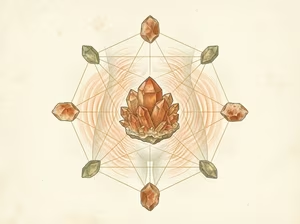
The stones most effective for crown chakra work share certain qualities: translucency, violet or white coloring, and a particular quality of stillness in the hand.
Amethyst is the primary crystal for the crown chakra across almost every tradition that works with stones. Its violet color maps directly onto the crown chakra’s hue, and its effect in practice is consistently calming without being sedating. I place amethyst above the head during lying-down energy sessions, or have clients hold it in the non-dominant hand during meditation.
Clear quartz amplifies crown chakra work already in progress. Because it’s energetically neutral, it doesn’t impose its own frequency; it magnifies whatever is already moving. In crown chakra grid work, I place a clear quartz point above the head and allow the other stones to work within the field it creates.
Selenite is particularly suited to the crown chakra because of its clearing quality. Sahasrara responds to a clean, uncluttered energetic field, and selenite wands drawn slowly above the crown — or placed vertically from crown to root during lying-down work — create that clearing effect reliably. I reach for selenite first when working with clients whose crown chakra blockage presents as chronic mental noise.
Fluorite in purple or clear form is associated with mental clarity and crown chakra activation. I find it useful specifically for people whose blockage shows up as an inability to settle mentally, the racing, fragmented attention that can’t find a still point.
Crown Chakra and Astrology
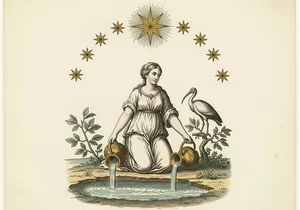
The planetary ruler of the crown chakra is Uranus, whose home sign is Aquarius. The Aquarian quality of detached, universal observation, the ability to hold a wide view without requiring personal investment in the outcome, is one expression of what crown chakra development looks like in a person’s character. Uranian energy at its clearest doesn’t analyze from outside the system; it perceives from a vantage point that includes the system entirely.
Pisces carries a different but complementary resonance with the crown chakra. Where Aquarius approaches the universal through principle and mental clarity, Pisces approaches it through dissolution and feeling, with ego boundaries becoming permeable. Both are pathways to the same opening that Sahasrara represents.
In tarot, The World corresponds most closely to crown chakra energy. It’s the final card of the Major Arcana, numbered 21, depicting the state of wholeness that arrives when every earlier card — every experience, loss, breakthrough, and reversal — has been fully integrated. A fully open crown chakra has this quality: nothing in experience is rejected or held at arm’s length.
Common Questions About the Crown Chakra
What does crown chakra chakra meaning actually refer to?
Crown chakra meaning describes the function of Sahasrara, the seventh energy center in the classical system. Understanding crown chakra chakra meaning fully means recognizing how this center governs the connection between individual awareness and universal consciousness, whether that’s understood as the divine, the collective, or simply the deepest layer of one’s own experience. In practical terms, it affects how easily the mind quiets, whether life feels meaningful, and how a person holds large questions about existence without being destabilized by them.
What causes crown chakra blockage?
The most common causes I see in practice are long-term intellectual hyperactivity without any contemplative counterbalance, spiritual trauma (particularly difficult experiences within organized religion), unresolved grief, and chronic disconnection from any form of practice that cultivates stillness. Some people develop crown chakra blockage simply from years of living in high-stimulus environments with no quiet.
How can I tell if my crown chakra is opening?
Signs include a mind that settles more readily during meditation, a stable inner sense that doesn’t require external validation, and occasional sensations of mild pressure, warmth, or expansion at the top of the head during practice. There’s often an increase in the capacity for wonder, a return of the quality of being genuinely moved by things that previously felt ordinary.
Can the crown chakra be overactive?
Yes. Overactivation typically presents as increasing disconnection from embodied life — difficulty eating regularly, loss of interest in relationships or practical tasks, and an excessive orientation toward spiritual or abstract concerns at the cost of everything else. The approach isn’t suppression but grounding through the lower chakras, especially root work.
Which crystals work best for the crown chakra?
Amethyst and clear quartz are the most consistently effective. Selenite is particularly good for clearing crown chakra blockage when it presents as chronic mental noise. Purple fluorite helps when the blockage shows up as an inability to settle into stillness.


