
Third Eye Chakra: Meaning, Location, and How to Balance It

The sixth energy center in the traditional chakra system, the third eye chakra sits in the center of the forehead, just above the bridge of the nose. Known in Sanskrit as Ajna — which translates roughly as “to perceive” or “to command” — this chakra governs intuition, inner vision, and the capacity to see beyond what the physical eyes register. In my practice, when clients describe persistent mental fog, difficulty trusting their instincts, or a sense that their thinking keeps circling the same ground without resolution, the third eye chakra meaning is where I start looking.
In this article:
- What It Is
- Signs of Balance and Imbalance
- How to Balance It
- Crystals
- Astrology Connection
- Common Questions

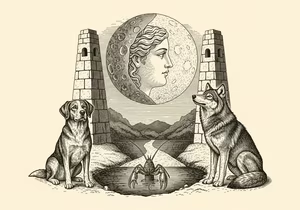


This chakra’s indigo color reflects concentrated, inward attention. Third eye chakra meaning centers on perception: how clearly you read situations, how reliably you access your own knowing, and how well you distinguish signal from noise in your inner life. Jupiter rules this energy center, linking it to expansion, philosophical inquiry, and the drive to understand larger patterns rather than reacting to surface events.
What Is the Third Eye Chakra
The third eye chakra is the sixth of the seven main energy centers, positioned at the forehead between the eyebrows. Its Sanskrit name, Ajna, appears in yogic texts dating back over two thousand years. Practitioners working within Vedic and Tantric traditions describe this center as the seat of higher perception, the faculty that synthesizes sensory data into understanding and filters experience through a lens of pattern recognition.
Third eye chakra location in the body corresponds to the area between the eyebrows, at the center of the forehead. In the brain, this position aligns with the pineal gland, a small endocrine structure involved in melatonin production and the regulation of sleep-wake cycles. Whether one approaches this from a metaphysical or physiological angle, the forehead marks a point where physical sensation and reflective awareness converge.
Key attributes from tradition and the standard chakra system:
- Number in sequence: 6
- Sanskrit name: Ajna
- Color: Indigo
- Element: Light
- Ruling planet: Jupiter
- Location: Center of the forehead, between the eyebrows
The third eye chakra explained through its elemental association with light carries a distinct meaning. Where the lower chakras correspond to earth, water, fire, and air, the sixth chakra works in the domain of perception itself: what the mind illuminates and what it keeps in shadow. Light here refers less to physical brightness and more to the quality of mental clarity: seeing what is actually present rather than what we expect or fear to find.
Signs of Balance and Imbalance
Third eye chakra balance or disruption shows up in recognizable patterns. Practitioners work with this center when clients report problems around clarity, judgment, or the ability to trust their own perceptions. The signs differ depending on whether the chakra is balanced, blocked, or overstimulated.
Balanced Third Eye Chakra
When the third eye chakra is functioning well, thinking stays clear even under pressure. People describe an ability to sense where a situation is heading before it fully unfolds. Not supernatural prediction, but the pattern recognition that comes from a quiet, observant mind. In my experience, clients who develop consistent meditation practice targeting the third eye chakra often report that decisions feel less labored. They describe trusting their first read of a person or situation more frequently and finding it accurate more often.
Creatively, a balanced third eye chakra often shows up as vivid visualization: the capacity to hold a mental image with enough stability to work with it, which supports planning, design, and artistic work alike. There’s also a quality of intellectual objectivity: the ability to step back from a situation and see it without the distortion of strong emotion or habitual assumption.
Blocked Third Eye Chakra
A blocked third eye chakra produces mental cloudiness, difficulty concentrating, and a persistent tendency to second-guess instincts after the fact. The physical sensations often associated with this state include headaches near the brow, sinus tension, and eye fatigue that rest doesn’t fully resolve.
Psychologically, a blocked third eye chakra can produce rigid thinking: the inability to perceive a situation from more than one angle, or a pattern of misreading social cues and interpersonal dynamics that others navigate more easily. Some clients describe a feeling of intellectual stagnation: reading the same situations incorrectly on repeat, unable to identify where their perception is catching.
Overactive Third Eye Chakra
On the other end, an overstimulated third eye chakra tends to produce disconnection from practical reality. I see this pattern in people who become absorbed in analysis and interpretation while neglecting concrete action. Vivid or disturbing dreams, racing thoughts at night, and heightened sensitivity to others’ emotional states can accompany an overactive third eye chakra. The physical sensations often associated with this state include pressure between the eyes, persistent headaches at the front of the skull, and difficulty falling or staying asleep.
The goal is a third eye chakra that contributes perceptual clarity without overriding the body’s more grounded signals from lower centers.
How to Open and Balance the Third Eye Chakra
These third eye chakra activities represent approaches I’ve found consistently useful across different practitioners. Energy work complements but doesn’t replace medical care.
Meditation: Bringing focused attention to the forehead point during seated practice is the most direct method available. I recommend starting with five uninterrupted minutes of simply resting awareness at the brow, without expectation of visual phenomena. Third eye chakra balance through meditation develops gradually. The improved concentration and intuitive accuracy that follows sustained practice is less dramatic than popular accounts suggest, and more reliable.
Sound: The bija mantra for this chakra is Om (sometimes written Aum). Chanting it at a comfortable pitch during meditation affects the third eye chakra through vibration in the head and sinus cavity. Frequencies around 852 Hz are associated with this center in sound healing practice.
Yoga postures: Child’s pose (Balasana), where the forehead rests on the mat, directly contacts the third eye chakra location. Downward-facing dog and seated forward folds also direct blood flow and awareness toward the head. Holding these postures with deliberate attention to the forehead point deepens the practice.
Affirmations: Phrases that reinforce perceptual clarity — “I see clearly,” “My perception is accurate,” “I observe without distortion” — work best when used during meditation rather than as casual background mantras. The shift from passive repetition to active attention makes the difference.
Journaling: Recording dreams and first-impression observations before analysis trains the capacity the third eye chakra governs. The practice doesn’t need to be elaborate: a few sentences on waking, or brief notes after significant conversations, builds the habit of attending to intuitive data before the analytical mind edits it.
Food associations: Indigo and purple foods (blueberries, blackberries, purple cabbage, dark grapes, eggplant) carry a traditional association with this chakra across several healing lineages. Whether the connection is energetic or symbolic, including them serves as a mindful anchor to this chakra’s themes.


Crystals for the Third Eye Chakra
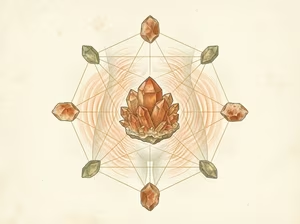
Stone-based work is one of the more concrete third eye chakra activities available to people outside a formal meditation tradition. Several stones carry strong associations with the sixth chakra across multiple healing lineages.
Amethyst sits close to the center of third eye chakra work in most Western crystal healing traditions. Its purple frequency resonates with the indigo of this chakra, and practitioners use it during meditation by placing a piece on the forehead while lying down. I keep an amethyst cluster near my workspace specifically for sessions involving clarity and decision-making work with clients.
Lapis Lazuli carries a long history as a stone of wisdom and clear perception. Ancient Egyptian and Mesopotamian traditions both valued it for insight. Its deep blue surface, flecked with gold, offers a useful visual anchor during meditation, and its connection to the third eye chakra through color and tradition makes it one of the most frequently recommended stones for this center.
Fluorite proves particularly useful when the third eye chakra presents as blocked: foggy thinking, scattered concentration, difficulty following a thought through to its conclusion. I’ve found it especially effective for clients who describe their thinking as “slippery” — the kind of mental fog that resists direct effort. Its structured crystalline geometry carries an ordering quality that supports focus when the mind keeps sliding off the task.
Sodalite works in a similar register, combining blue and white in a pattern associated with rational thought, clear communication, and the integration of intuitive and analytical perception. In my work, I often reach for sodalite when clients present with an overactive third eye chakra producing excessive rumination or mental overload — its steadier quality tends to bring relief where more activating stones would make things worse.
To work with these stones: place one on the forehead during a ten-to-fifteen minute rest, hold one during seated meditation, or keep one on a desk during focused work. Direct contact with the third eye chakra location during lying-down practice is the most traditional application.
Third Eye Chakra and Astrology
Jupiter governs the third eye chakra, and that planetary association clarifies how this center expresses itself at its best. Jupiter’s themes — philosophical inquiry, long-range vision, the desire to understand rather than merely react — mirror what a well-functioning sixth chakra supports.
Sagittarius, ruled by Jupiter, shares this orientation. The archer aims at a distant target, operating by an awareness of wider patterns rather than immediate concerns. Practitioners who work with this astrological connection often find that clients with strong Sagittarian placements engage naturally with intuitive practices, though they sometimes need work on grounding perception in the present rather than the abstract.
The Lovers tarot card, the sixth card of the Major Arcana, carries a numerological connection to this chakra. Its central theme — choosing with genuine discernment, seeing a situation clearly enough to act well within it — reflects precisely what this chakra governs. The card’s image of a decisive moment mirrors the perceptual quality this chakra supports: seeing the fork in the road and knowing, without excessive deliberation, which path serves.
For context within the full system, the solar plexus chakra sits three positions below, governing personal will and directed action. The relationship between the solar plexus’s drive and the third eye’s perception, between what we push toward and what we actually see clearly, represents one of the more productive areas to explore in a sustained chakra practice.
Common Questions About the Third Eye Chakra
What does third eye chakra meaning actually refer to?
The third eye chakra meaning centers on perceptual capacity: the ability to access reliable intuition, synthesize information accurately, and read patterns in situations that aren’t obvious on the surface. It’s less about mystical sight and more about the quality and honesty of your attention.
What chakra is your third eye?
The third eye corresponds to the sixth chakra in the traditional system. Its Sanskrit name is Ajna. It sits at the center of the forehead, between the eyebrows, and governs intuition, inner vision, and mental clarity.
How do I know if my third eye chakra is blocked?
Common indicators include persistent mental fog, difficulty making decisions without prolonged second-guessing, and a sense of disconnection from your own instincts. Physically, recurring headaches near the brow or chronic tension behind the eyes often accompany blockage in this center.
What are the best third eye chakra activities for beginners?
Resting focused awareness on the forehead point during a few minutes of daily seated practice is the most direct starting point. Journaling first impressions before analysis also builds the perceptual capacity this chakra governs. Placing an amethyst or lapis lazuli on the forehead during a short rest provides a concrete, accessible entry point for those newer to energetic work.
What is the third eye chakra explained for everyday use?
Third eye chakra balance shows up practically as clearer judgment, more reliable pattern recognition, and less internal noise around decisions. People describe it as knowing what they think before they’ve finished deliberating, a quality of settled perception that makes navigation through complex situations noticeably easier.


