
Heart Chakra Meaning, Location, and How to Balance It

The heart chakra, called Anahata in Sanskrit (meaning “unstruck” or “unbeaten”), is the fourth of the seven main chakras, positioned in the center of the chest. Its color is green, its element is air, and Venus is its ruling planet. This energy center governs love, compassion, forgiveness, and the capacity to form genuine connection. In my practice, I’ve found this to be the chakra where the most significant relational breakthroughs happen — and also where the deepest grief tends to accumulate quietly for years. When the heart chakra is open, you can give and receive care without exhausting yourself or shutting others out. When it’s blocked or off-balance, grief, resentment, and emotional withdrawal tend to settle in. Heart chakra meaning, in practice, comes down to this: it’s the bridge between the body’s grounding energy below and the more abstract, spiritual energy above. To understand heart chakra meaning is to understand the point in the body where the physical and the relational meet.
In this article:


What Is the Heart Chakra
The heart chakra sits in the center of the chest, at the level of the sternum, with its energy extending toward both the front of the body and the upper back between the shoulder blades. Heart chakra location is significant physically as well as energetically, since the thymus gland, which plays a central role in immune function, sits in this same region.
In the sequence of seven chakras, the heart chakra holds the fourth position: three below (root, sacral, solar plexus) and three above (throat, third eye, crown). That central placement is why practitioners often describe the heart chakra as a relay point. In my experience working with clients, people who focus on heart chakra practice tend to notice shifts throughout the whole system, because this fourth energy center functions as a connector between the two halves.
Core attributes:
- Number: 4
- Sanskrit name: Anahata (“unstruck sound”)
- Color: Green (also associated with soft pink for the emotional dimension)
- Element: Air
- Planet: Venus
- Location: Center of chest, behind the sternum
- Associated glands: Thymus
- Governs: Love, compassion, grief, forgiveness, boundaries, emotional equilibrium
The name Anahata refers to the sound that exists without two things striking each other, a concept that points to unconditional love, which doesn’t require a trigger or a transaction. Whether or not you work in an energetic framework, that idea has a practical application: the heart chakra represents the capacity to feel care that isn’t contingent on being cared for first.
Signs of Balance and Imbalance
When the Heart Chakra Is Balanced
A functioning heart chakra shows up most clearly in how you relate to people and to yourself. Clients I’ve worked with who have a genuinely open fourth chakra tend to describe their emotional life in terms of ease rather than effort. They give support without keeping score. They can accept help without deflecting or minimizing it. They move through loss and disappointment without armoring completely against the next relationship.
Physically, a balanced heart chakra often correlates with relaxed chest musculature, natural deep breathing, and a resting state that feels open rather than braced. Many people describe the sensation as their chest feeling “light” or “spacious,” a contrast to the tightening that signals restriction.
Emotional markers include steady empathy without absorbing everyone else’s distress, the ability to draw limits without guilt, and genuine forgiveness. Not forgetting, but releasing the held tension of old hurt.
When the Heart Chakra Is Blocked
A blocked heart chakra tends to produce a pattern of emotional withdrawal and protective isolation. Grief that has nowhere to go often settles here. So does anger that’s been suppressed or turned inward. People working through heart chakra restriction frequently describe feeling disconnected from others even in close relationships, present physically but unable to reach across the emotional distance.
In my work, I’ve consistently observed that physical restriction in the fourth chakra shows up as tightness in the chest, shallow or held breathing, and chronic tension between the shoulder blades. Some clients also notice that their posture curls inward, shoulders rounding forward as if guarding the chest.
Emotional signs: difficulty accepting love or care, chronic loneliness, persistent resentment, holding onto past grievances, and a sense of not deserving closeness.
When the Heart Chakra Is Overactive
An overactive heart chakra doesn’t look like boundless warmth. It tends to look like depletion. The most common pattern is over-giving: taking responsibility for everyone else’s emotional state, losing personal limits in relationships, and deriving worth almost entirely through caretaking others.
Clients with a fourth chakra running too hot often describe exhaustion in relationships rather than fulfillment. They find it nearly impossible to say no. They feel guilty setting any limit at all. The work here isn’t about opening up more. It’s about holding something back for yourself, which is itself a form of heart chakra balance.
How to Open and Balance the Heart Chakra
Energy work complements but doesn’t replace medical care. These are practices I return to consistently in my work with clients addressing heart chakra imbalance.
Breathwork. The element of the heart chakra is air, which makes the breath the most direct tool available. A simple practice: inhale for four counts, expanding the chest fully, then exhale slowly for six counts. Five minutes of this daily tends to produce a noticeable shift in chest tension. I recommend doing it before any other heart chakra work.
Yoga poses. Backbends open the front of the chest and counteract the protective forward curl many people carry. Camel pose (Ustrasana), bridge pose (Setu Bandha Sarvangasana), and cobra (Bhujangasana) are the three I recommend most consistently. Even something simpler, clasping the hands behind the back and gently drawing the shoulder blades together, can create an immediate physical opening.
Mantra and sound. The seed mantra for the heart chakra is YAM (pronounced “yum”). Chanting it during meditation, or listening to tones in the 639 Hz range, is a practice used by many energy workers to support this chakra’s function. Sound-based work tends to be especially effective for people who find visualization difficult.
Affirmations. Generic affirmations do less than people expect. What tends to work better is addressing the specific imbalance directly. For a blocked heart chakra: “I allow myself to receive care.” For an overactive one: “I give from fullness, not from obligation.”
Green environments. Time in forests, gardens, or parks has measurable effects on nervous system function, and green is the heart chakra’s primary color. This is one of the simplest, most accessible forms of heart chakra support, and it costs nothing.
Foods. Green foods have a traditional association with the fourth chakra: leafy greens, broccoli, green apples, kiwi, avocado. The link is partly symbolic, partly the genuine cardiovascular and respiratory value of these foods.


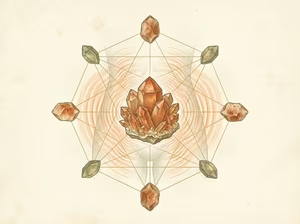
Crystals for the Heart Chakra
Crystal work is useful for heart chakra practice precisely because it’s tactile. Something you can hold, place on your chest during meditation, or keep nearby as a physical anchor for the intention of the work.
Rose quartz is the most consistently used stone for heart chakra work. Its soft pink color corresponds to the self-compassion and grief-processing dimensions of the fourth chakra. Rose quartz is the heart chakra stone I reach for most often in practice, particularly for clients working through loss or learning to extend kindness toward themselves.
Green aventurine aligns with the primary green color of the heart chakra and is associated with releasing habitual emotional patterns and encouraging ease in relationships. Aventurine is a good starting stone for people new to crystal work, gentle and accessible.
Rhodonite, pink with dark veining, focuses specifically on emotional wounds and the process of forgiveness. Rhodonite comes up most in my practice when clients are working through past relationship damage rather than present connection difficulties.
Malachite is a more intense stone, linked to emotional clearing and bringing suppressed patterns to the surface. Malachite is better suited to experienced practitioners and should never be used in water due to its copper content.
To use these stones, hold them at the center of the chest during breathwork or meditation, or place them near you while resting. Five to ten minutes daily tends to be more effective than infrequent longer sessions.
Heart Chakra and Astrology
Venus governs the heart chakra, connecting it to the two signs Venus rules: Libra and Taurus.
Libra carries the relational dimension, the desire for genuine partnership, fairness, and harmony. When Libra energy is strong in someone’s chart, heart chakra patterns often show up in how they manage conflict: can they stay present in disagreement without emotionally retreating, or do they collapse their own position to keep the peace?
Taurus brings the self-worth and sensory dimensions of Venus, physical comfort, pleasure, and the belief that one deserves good things. Heart chakra work for Taurus-prominent charts frequently centers on self-trust: allowing ease, receiving without guilt, and staying present in the body rather than intellectualizing feeling.
In the tarot, the fourth major arcana card is The Emperor. This may seem like an unexpected pairing with a chakra centered on love, but The Emperor represents the structural conditions that allow love to be sustained: reliability, consistency, and the kind of grounded presence that makes relationships feel stable rather than precarious.
The solar plexus chakra sits directly below the heart chakra in the sequence and governs personal power, self-worth, and willpower. Working with the third chakra’s themes tends to create a foundation for heart chakra opening, because it’s difficult to give freely from a place of love when the sense of self beneath it feels unstable.
Common Questions About the Heart Chakra
What does heart chakra chakra meaning refer to in energy work?
Heart chakra chakra meaning refers to the energetic and symbolic significance of the fourth energy center in the body’s chakra system. Practitioners use this term when discussing what the heart chakra governs, how it functions, and what it means for someone’s emotional and relational life when it’s open, blocked, or overactive.
What is the heart chakra location, and why does it matter?
The heart chakra location is the center of the chest, roughly at the level of the sternum, extending into the upper back. Its location matters because it corresponds to the thymus gland and the respiratory region, two systems directly affected by stress, grief, and chronic emotional constriction.
How do I know if my heart chakra is blocked?
The most common signs include persistent emotional withdrawal, difficulty accepting care from others, chest tightness without a clear physical cause, chronic resentment or grief, and a sense of fundamental disconnection even in close relationships.
What does heart chakra balance actually feel like?
Heart chakra balance feels like ease in connection: giving without depletion, receiving without discomfort, and moving through hurt without armoring. Most people describe it as a physical sensation of openness in the chest rather than an abstract emotional state.
How often should I practice heart chakra work?
Consistency matters more than intensity. Five to ten minutes of daily breathwork, meditation with a stone on the chest, or time outdoors in green spaces tends to produce more sustained shifts than occasional longer sessions. A restricted heart chakra that developed over years of relational difficulty won’t fully open in a single meditation session.


