
Amazonite Crystal Properties: Meaning, Uses, and Healing Benefits

Amazonite is a blue-green feldspar mineral that practitioners have used for thousands of years in jewelry, amulets, and energy work. I keep a tumbled piece on my desk because I’ve noticed it tends to soften the mental noise during stressful days. Something about the cool, watery green pulls the mind down a notch. Amazonite meaning in modern practice centers on two interconnected themes: emotional balance and honest communication. Those amazonite crystal properties build outward from that core. The stone aligns with both the heart and throat chakras, which explains why people reach for it before difficult conversations or during anxious stretches. Physically, amazonite ranges from pale mint to deep teal, often threaded with white or grey veining. It registers 6 to 6.5 on the Mohs hardness scale. If you’re relatively new to working with stones, amazonite is an accessible entry point: the energy is approachable, the appearance immediately striking, and the applications practical enough to incorporate into ordinary days.
In this article:
- Properties
- Spiritual and Healing Properties
- Chakra Connection
- Zodiac Signs
- How to Use
- Crystal Combinations
- Common Questions


Properties and Physical Characteristics
Amazonite belongs to the feldspar mineral group, specifically the potassium feldspar variety called microcline. Its blue-green color comes from trace amounts of lead and water within the crystal structure. The stone forms in igneous rocks and pegmatites, and notable deposits are found in Colorado (USA), Brazil, Russia, and Madagascar.
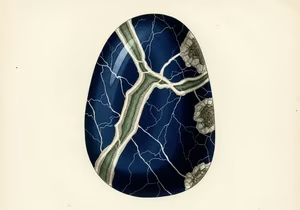
The amazonite properties most visible to the eye are its opaque to semi-translucent finish and the white or cream streaks running through the green matrix. Color varies considerably across specimens: some pieces lean toward pale aqua, others toward a deeper teal with hints of blue. The stone is most often polished into cabochons or tumbled forms for jewelry and healing work, though raw specimens have a rougher, more textured presence that many practitioners prefer for stationary use.
Hardness at 6 to 6.5 Mohs makes amazonite moderately durable. It holds up well in pendants and earrings, though it will scratch if rubbed against harder stones like quartz or topaz. Clean amazonite with a soft dry cloth. Avoid prolonged soaking or water immersion, and do not use amazonite in water-infused elixirs or gem water, as the stone contains trace lead and is not safe for ingestion.
Spiritual and Healing Properties
Amazonite meaning in ancient Egypt ran through the culture’s deepest symbols: the stone was carved into amulets and set into jewelry, and was recovered from Tutankhamun’s tomb. Those healing traditions stretch back to that same period, when amazonite was treated as a material with genuine protective and communicative significance. The stone also appears in various pre-Columbian pieces from South America, likely the source of the name through its connection to the Amazon River region, even though amazonite deposits there are sparse.
In current practice, amazonite is used primarily for calming overthinking and easing anxiety. Many practitioners find that holding amazonite during meditation shifts the mental state from reactive to more measured, the kind of internal shift that makes it easier to respond rather than just react. I’ve noticed this stone tends to come up most often for people who describe themselves as chronic overthinkers or as people-pleasers, which tracks with its association with communication and emotional boundaries.
Amazonite is also linked to truth-telling and integrity. The traditional use is to carry or wear amazonite when you need to say something honest but difficult: an uncomfortable conversation, a boundary you’ve avoided setting, a creative risk that requires you to put something real forward. Some practitioners work with amazonite specifically to counteract patterns of self-suppression, the habit of holding back genuine reactions to keep peace.
Amazonite crystal properties in the witchcraft tradition similarly emphasize truth and protection. The stone appears in cord magic and intention-setting work focused on communication, self-expression, and speaking without fear. Some practitioners incorporate amazonite into altar arrangements for Mercury retrograde periods, when miscommunication tends to run high.
The stone appears under names like “hope stone” and “stone of courage” in various lapidary traditions. These names reflect the core of amazonite healing: finding the voice to say what needs to be said.
Chakra Connection
Amazonite chakra work spans two energy centers: the heart chakra (Anahata) and the throat chakra (Vishuddha). This dual alignment is fairly unusual. Most stones associate strongly with a single chakra, but amazonite bridges the two, which is what makes it useful for situations where feeling and speaking need to connect.
The heart chakra governs love, compassion, grief, and emotional openness. Placing amazonite on the chest during a body scan meditation is a practice often used to address accumulated emotional armor, the guardedness that accumulates after loss, disappointment, or prolonged stress. In my experience, this stone tends to come up for people navigating transitions: a relationship ending, a job shift, a period of grief. The heart chakra work with amazonite is less about opening wide and more about steadying, finding a stable emotional ground.
The throat chakra governs communication, authenticity, and self-expression. Wearing amazonite as a pendant or placing it at the throat during breathwork are common approaches. The connection to both chakras is the defining feature of how most people experience amazonite: it creates a kind of bridge between what you feel and what you’re actually able to say. That gap — between felt experience and spoken expression — is what amazonite seems to address most directly.
Amazonite and Zodiac Signs
Amazonite carries a natural affinity with Virgo and Aquarius, two signs that both have a complex relationship with communication.
For Virgo, whose energy orbits precision, service, and a relentless internal audit of everything, amazonite offers a useful counterbalance. Virgo placements often notice themselves editing their words before speaking, smoothing down observations to make them more palatable. Amazonite supports the move toward honest expression without losing Virgo’s characteristic thoughtfulness. Explore Virgo for more on this sign’s traits.
For Aquarius, the connection runs through the sign’s association with collective truth-speaking. Aquarius at its clearest is the voice that names what others observe but hesitate to say aloud. The heart-throat channel that amazonite works with aligns with Aquarius’s best qualities. Aquarius placements sometimes hold back out of social anxiety or fear of being seen as eccentric; amazonite tends to reduce that friction. Read more at Aquarius.
It’s also worth noting that Aquarius is associated with The Star tarot card, a card of hope, clarity, and calm after difficulty. If you’re drawn to both amazonite and that card, there’s a real thematic overlap: both carry the quality of post-storm stillness and clear seeing.


How to Use Amazonite
Amazonite uses fall into a few practical categories, each connecting directly to the stone’s core properties. Here are the approaches I’ve seen work consistently:
In meditation: Hold a tumbled amazonite in your left hand and rest your attention on the throat or chest. Five to ten minutes before a conversation you’re anxious about is one of the most practical applications I know. The physical sensation of the cool stone has a mild grounding effect that most people notice within a few minutes.
As jewelry: Wearing amazonite as a necklace or pendant keeps it close to the throat and heart throughout the day. Many people find they instinctively reach for their amazonite pieces during high-stress weeks, which is a useful signal in itself — the body notices what it needs.
At a desk or workspace: Keeping amazonite on a desk is one of the simplest ways to work with the stone. A raw slab or a larger tumbled piece works well. The visual reminder to pause before reacting has value entirely separate from any metaphysical effect.
Before difficult conversations: Some practitioners hold amazonite briefly or put it in a pocket before conversations they’re dreading. The ritual of pausing, holding the stone, and setting an intention to communicate honestly is often as useful as any specific property attributed to amazonite.
Cleansing and charging amazonite: Cleanse by smudging (sage, palo santo, or incense smoke), by setting it on selenite overnight, or by using sound (singing bowls or bells work well). Avoid water-based cleansing and do not leave amazonite in direct sunlight for extended periods, as UV exposure can gradually fade the color. No crystal replaces professional medical or psychological care; amazonite is a supportive practice tool, not a treatment.
Amazonite Crystal Combinations
Pairing amazonite with other stones shifts or extends its focus. In my practice, I’ve found amazonite works best as part of a combination when the work involves both heart and voice — the stone rarely needs to work alone. A few combinations worth knowing:
Amazonite and rose quartz: Both stones connect to the heart chakra but in different registers. Amazonite brings clarity and courageous expression; rose quartz brings softness and acceptance. Together, they support conversations about love or loss that require both honesty and gentleness. Rose quartz is well documented for heart-centered work.
Amazonite and lapis lazuli: Both stones appear in ancient Egyptian contexts, and both connect to clear expression. Lapis lazuli adds a quality of authority and depth to amazonite’s communicative openness. The combination is traditionally associated with speaking truth with confidence, useful for public speaking, important negotiations, or creative presentations. See lapis lazuli for more on that stone’s properties.
Amazonite and black tourmaline: This pairing addresses communication under pressure. Amazonite opens expression; black tourmaline provides grounding protection. People who work in emotionally charged environments (therapists, teachers, caregivers) sometimes use this combination to support both authentic expression and energetic boundaries. Black tourmaline has its own extensive protective properties worth reading.
Amazonite and sodalite: Both are blue-toned stones with throat chakra connections. Sodalite adds intellectual clarity that pairs with amazonite’s emotional clarity, a useful combination for situations that are both emotionally loaded and logically complex, like mediation or structured feedback conversations. Compare with sodalite for the distinction.
Amazonite and turquoise: Both stones are blue-green and both carry healing traditions. Turquoise is slightly more protective and grounding; amazonite is slightly more expressive and communicative. They can be used together, though many practitioners work with one or the other rather than both. Turquoise has its own page for direct comparison.
Common Questions About Amazonite
What is amazonite good for?
Amazonite is used for calming anxiety, supporting clear and honest communication, and working with the heart and throat chakras. Practitioners reach for it most often during periods of interpersonal stress, difficult conversations, emotional transitions, or any situation where the gap between feeling and speaking needs to close.
Is amazonite the same as turquoise?
No. Amazonite and turquoise are different minerals. Turquoise is a copper-based phosphate with a matrix of brown or black veining; amazonite is a potassium feldspar with characteristic white or grey streaks. Both are blue-green, but a side-by-side comparison makes the difference clear. See the turquoise page for a direct look at that stone’s properties.
Can amazonite go in water?
Amazonite should not be used in water elixirs or gem water intended for drinking. The stone contains trace lead from its mineral composition, which makes water infusion unsafe for consumption. Brief contact with water for surface cleaning is fine, but avoid extended soaking.
What chakra does amazonite work with?
Amazonite connects with both the heart chakra and the throat chakra. This dual connection is one of the stone’s defining characteristics. Amazonite chakra work focuses on building the channel between emotional experience and verbal expression, between what you feel and what you’re able to say honestly.
How do I tell if my amazonite is real?
Genuine amazonite will have irregular, natural-looking color variation: patches of deeper and lighter green-blue with white or cream veining that runs through the stone organically. It feels cool and slightly dense. Dyed howlite is sometimes sold as amazonite; synthetic versions tend toward unnaturally even color. If you’re uncertain, a gemologist or mineral dealer can confirm the identity under magnification.


