
Carnelian Meaning: Properties, Uses, and Healing Benefits

Carnelian is a warm, orange-red chalcedony that has been used for thousands of years to build courage, spark creativity, and restore physical vitality. Carnelian properties include strong fire energy, sacral chakra activation, and a consistent ability to move through stagnation — this stone is for people who feel stuck, uninspired, or emotionally flat. Carnelian meaning centers on action and momentum. I keep a tumbled piece on my writing desk, and on the days I actually pick it up and hold it before starting work, the resistance to beginning tends to dissolve faster than on days I ignore it.
In this article:


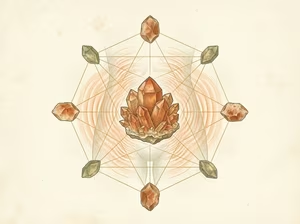
Carnelian meaning connects directly to fire energy, the sacral chakra, and the will to move forward. Carnelian properties and that meaning work together — the stone’s warmth is not just visual but felt, and the warmer, deeper specimens tend to feel more grounding in the hand. Whether you’re drawn to this stone for creative work, emotional healing, or protection during travel, it rewards close acquaintance.
Properties and Physical Characteristics
Carnelian properties that make this stone immediately recognizable: the warm orange-to-red color, the waxy surface sheen after polishing, and a slight translucency when held to the light. It is a variety of chalcedony (itself a microcrystalline form of quartz), and its distinctive color comes from iron oxide distributed throughout the silica matrix.
Hardness: 6.5 to 7 on the Mohs scale. This makes it durable enough for daily wear as rings, pendants, or pocket stones without significant surface damage from normal use.
Color: Ranges from pale peachy-orange to deep brownish-red. The term “sard” appears in older lapidary texts for the darker red-brown variety, though modern usage often groups these together as carnelian.
Crystal system: Trigonal. The microcrystalline structure means individual crystals are invisible to the naked eye, giving polished specimens their characteristic smooth, opaque-to-translucent appearance rather than a faceted crystalline form.
Primary sources: India, Brazil, Madagascar, and Uruguay produce most commercial carnelian. Historical sources included Egypt and the Arabian Peninsula, where the stone was prized for signet rings, cylinder seals, and burial jewelry dating back at least to 3000 BCE. The ancient Egyptians associated it with protection and resurrection, and it appears frequently in tomb inventories.
Carnelian is safe for water contact. Unlike selenite, which dissolves, or hematite, which rusts, it can be cleansed under running water without damage. Extended salt water exposure can dull the surface polish, but brief water contact is fine.
Spiritual and Healing Properties
Carnelian’s spiritual properties cluster around three consistent themes across traditions: action, creative fire, and emotional courage.
Action and motivation. Carnelian healing traditions focus on overcoming apathy and fear-based paralysis. I’ve noticed this stone tends to surface when someone is procrastinating on something they genuinely want to do — the gap between intention and action. Traditional practitioners placed the stone on workspaces, carried it in pockets, or wore it as rings specifically to maintain forward drive when motivation wavered.
Creative expression. The metaphysical properties of carnelian connect strongly to the creative center. Artists, writers, and craftspeople have reportedly kept carnelian in studios for centuries, not as superstition but as a tactile anchor that interrupts mental loops and signals the body that it’s time to work. Whether the effect is energetic or psychological, the habit of reaching for a physical object tied to creative intention has real behavioral effects.
Emotional courage. The love applications of carnelian come from the same fire energy — the willingness to show up emotionally, to be present and vulnerable in relationships rather than withdrawn. Many practitioners work with this stone during periods of emotional numbness or after relational hurt, finding that its warmth reflects something back.
Carnelian healing in physical traditions emphasized circulation, vitality, and reproductive health. Crystal therapy practitioners working with lower abdominal concerns or lower back tension often place carnelian in that region during sessions. I’m clear with everyone I work with: no crystal replaces medical care, and carnelian healing is a complementary practice, not treatment.
Witchcraft and folk magic. Carnelian’s witchcraft applications are among the oldest recorded uses of any stone. Sumerian priestesses, Roman soldiers, and Arabic scholars all wrote about it as protection during travel and a ward against bad luck. Contemporary witches use the stone in fire magic, confidence workings, and protection sachets. A small carnelian piece tucked into a red cloth bag with bay leaf and cinnamon is a common working for courage before a difficult situation.
Chakra Connection
Carnelian chakra work primarily targets the sacral chakra (Svadhisthana), the second energy center in the traditional seven-chakra system. The sacral chakra sits roughly two inches below the navel and governs creativity, pleasure, sensuality, emotional flow, and the quality of relationships with others.
Orange is the color associated with this chakra — which lines up naturally with carnelian’s warm hues. In my practice, sacral chakra imbalances show up as creative blocks, difficulty experiencing pleasure, emotional flatness, or trouble connecting in relationships. These are exactly the areas where carnelian properties and benefits tend to be most consistently useful.
Working with carnelian on the sacral chakra:
1. Lie down and place a tumbled carnelian on your lower abdomen, two fingers below the navel.
2. Breathe slowly and direct attention into that area for five to ten minutes.
3. Visualize an orange-amber warmth expanding from the stone outward with each inhale.
Many people report a distinct physical warmth from carnelian during this practice — noticeably different from cooler stones like amethyst or lapis lazuli.
Carnelian also works with the root chakra in its deeper red specimens. The root chakra governs safety, grounding, and the basic felt sense of security. People who need both grounding and creative momentum can use it as a bridge stone between the first and second chakras.


How to Use Carnelian
Carnelian uses range from pocket stones to altar placements to meditation tools. The stone is versatile enough to fit nearly any practice. In my experience, the key is consistency — even brief daily contact produces more noticeable results than occasional ceremonial use.
Carry it as a pocket stone. The simplest carnelian use is to put a tumbled piece in your pocket in the morning. Roll it between your fingers during transitions, before meetings, or when procrastination starts pulling. The physical contact serves as a reset point.
Wear it. Carnelian jewelry — rings, pendants, bracelets — keeps the stone in contact with skin through the day. The stone is hard enough for daily wear. Traditional use favored carnelian rings on the index or middle finger of the dominant hand.
Place it in your workspace. A larger carnelian specimen on a desk or art table is a time-tested placement for creative work. I keep mine next to my writing space and notice a genuine difference in how readily I start versus how long I delay. Some practitioners also keep carnelian near their front door as an energetic confidence boost before leaving the house.
Carnelian properties and uses in meditation are direct: hold it in your dominant hand or rest it on the sacral chakra during seated practice. Orange-focused visualization pairs naturally. I’ve found five minutes with carnelian in hand before a difficult task consistently shifts mental state — the resistance to starting tends to drop noticeably.
Pair it with complementary stones:
– Citrine amplifies carnelian’s creative and energetic qualities with an abundance angle.
– Garnet shares the fire energy but adds a more rooted, earthy quality that grounds carnelian’s more dynamic push.
– Aventurine brings heart energy into the mix, balancing the gut-level courage carnelian offers with emotional openness.
Cleansing and recharging. Run carnelian under cool water for a minute or two to clear accumulated energy. Sunlight recharges it well — an hour on a windowsill is enough, and fire-element stones like carnelian respond particularly strongly to solar light. Unlike some crystals, carnelian handles both water and sunlight without damage.
Carnelian and Zodiac Signs
Carnelian has well-documented associations with three zodiac signs:
Aries is the primary carnelian zodiac sign — the fire sign ruled by Mars aligns almost perfectly with carnelian’s core themes of courage, action, and initiative. Traditional gemological texts going back to the Renaissance associate it with Aries. Aries individuals who already run hot may want to balance carnelian with a cooler stone like lapis lazuli or sodalite. For more on Aries energy and how it maps to carnelian’s action-oriented properties, see Aries zodiac sign.
Leo shares the fire element and benefits similarly from carnelian’s creative and performance-related properties. Carnelian for Leo emphasizes visibility, creative confidence, and the willingness to be seen.
Virgo appears consistently in historical lapidary texts as a carnelian sign, though it’s less intuitive given Virgo’s earth-element nature. The traditional logic was that carnelian helps Virgo overcome overthinking and analysis paralysis, moving from planning into action.
Carnelian’s fire energy also connects to fire-element tarot cards. The Ace of Wands shares carnelian’s energy of creative ignition, new beginnings, and the spark of motivated action — if you’re working with this card in readings, carnelian is a natural pairing.
Common Questions About Carnelian
What are the main carnelian properties?
Carnelian properties include courage, creativity, motivation, and physical vitality. The stone connects to the sacral chakra and fire element, making it most useful for creative blocks, low-energy periods, and building emotional courage in relationships.
What do carnelian properties and benefits include for daily use?
For daily use, carnelian properties and benefits center on sustained motivation and creative energy. Carrying or wearing carnelian through the day is the most accessible approach — the stone’s effects tend to be subtle and cumulative rather than dramatic.
What does carnelian mean spiritually?
Spiritually, carnelian focuses on action over stagnation. Practitioners have used this stone across cultures to ward off apathy, overcome fear of starting, and build the kind of courage that comes from the gut rather than the head.
Can carnelian be used in water rituals?
Yes. Carnelian is listed among water-safe crystals and can be cleansed under running water or briefly submerged without damage. Avoid extended salt water soaking, which can dull the surface over time.
What crystals work well with carnelian?
Effective carnelian combinations include citrine for creative abundance, garnet for grounded fire energy, and aventurine for heart-centered balance. Cooler stones like amethyst can temper carnelian’s activating qualities when needed.


