
Opal Meaning: Properties, Uses, and Healing Benefits

Understanding opal meaning starts with looking at what the stone actually does: it holds an entire light show inside a single gemstone. The shifting play of color (blues, greens, reds, and golds dancing across the surface) isn’t just beautiful; it reflects what opal meaning is really about energetically: the full spectrum of human emotion and creative potential. Opal properties center on amplification and inspiration, which makes it one of the more unusual stones to work with. Unlike grounding crystals such as black tourmaline or hematite, opal opens rather than stabilizes. I’ve noticed this stone tends to surface unresolved emotional patterns, which is why some people find it intense and others find it deeply freeing. For anyone drawn to creativity, emotional fluidity, or sharpening intuitive perception, understanding its properties from the ground up is worth the time.
In this article:


Properties and Physical Characteristics
Opal’s most distinctive feature is its internal architecture. Unlike most crystals, it is technically a mineraloid, lacking the ordered atomic lattice of a true crystal. Instead, it’s composed of tiny silica spheres arranged in a loose three-dimensional grid. When light enters the stone and diffracts off these silica layers, it produces the “play-of-color” effect unique to precious opal. No two specimens display exactly the same pattern.
Opal properties vary considerably by type:
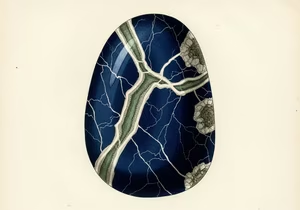
- Precious opal, the type most people recognize, shows the color play in shades of blue, green, red, orange, and violet against a white or transparent base.
- Black opal, found mainly at Lightning Ridge in New South Wales, shows the most vivid color display because the dark background increases contrast. It’s also the rarest and most valuable variety.
- Boulder opal forms in ironstone host rock, filling natural cracks and voids. The ironstone is usually left attached, creating distinctive matrix patterns.
- Fire opal, primarily from Mexico, ranges from yellow through orange to red. It may or may not show color play; the value here comes from the warm body color itself.
- Common opal lacks color play entirely and appears milky, pastel, or opaque.
On the Mohs hardness scale, the stone sits between 5.5 and 6.5, softer than quartz and more fragile than most precious gemstones. One of the key opal properties is a water content of 3 to 21 percent within its silica structure, creating a sensitivity that collectors and wearers both need to understand. Sudden temperature shifts, extended sunlight exposure, and prolonged contact with water can cause crazing, the network of fine internal cracks that forms when the stone dries unevenly. Major deposits: Australia supplies over 90 percent of the world’s precious opal, with Ethiopia, Mexico, Brazil, and Nevada rounding out the main sources.
Spiritual and Healing Properties
Opal healing properties have been recognized across many traditions, though interpretations run in opposite directions depending on culture and era. In ancient Rome, the stone ranked above all other gemstones precisely because it seemed to contain every other gem’s color within itself. The Latin opalus carried connotations of luck and hope. Aboriginal Australians, on whose land most of the world’s opal forms, have origin stories where the stone marks the spot where the creator descended to earth on a rainbow. European medieval tradition, by contrast, associated it with misfortune, largely because the iridescence was misread as an unstable omen.
In current practice, opal healing properties cluster around three main areas.
Emotional amplification. Opal doesn’t soothe emotions or buffer against them; it intensifies what’s already present in your emotional field. Many practitioners find this quality useful for working through grief, creative blocks, or patterns that have been suppressed rather than processed. The experience can feel overwhelming if you’re not ready for that kind of openness. I usually recommend pairing it with amethyst or black tourmaline, which offer stability during emotional surfacing. The two stones together seem to create a more workable combination than working with opal alone.
Creative activation. This is the most consistently reported quality of the stone in practice. Writers, visual artists, and musicians are drawn to it more than most other crystals. Opal appears to quiet the internal critic, the filtering mechanism that discards ideas before they reach the page or canvas. I’ve noticed it tends to work best for people who feel creatively blocked rather than those who are already producing at high volume; people with active creative output sometimes find the stone disorganizing rather than generative.
Intuitive sharpening. Because opal amplifies rather than filters, practitioners working with divination, dreamwork, or intuitive reading often keep a piece nearby as a kind of receiver. Opal healing properties in this context aren’t about gaining new perceptions; they’re about clarifying what you already sense but haven’t articulated. I’ve worked with clients who felt this stone sharpened their dream recall more reliably than most other crystals they’d tried.
One note that belongs in this section: no crystal, opal included, substitutes for medical or psychological treatment. These observations come from practice and traditional use.
Chakra Connection
Opal chakra associations most commonly point to the crown and third-eye chakras, with secondary connections to the sacral chakra depending on the variety.
Crown chakra (Sahasrara, 7th): White and light-colored specimens connect with the crown, supporting meditation and the expansive quality practitioners describe as “opening upward.” The crown governs consciousness, transcendence, and the relationship between individual identity and something larger. Opal’s ability to hold and display multiple colors simultaneously maps directly onto this quality; the crown doesn’t favor one frequency.
Third-eye chakra (Ajna, 6th): Boulder opal and darker varieties work well with the third eye, supporting visualization and dreamwork. The opal chakra connection here is about sharpening perception rather than widening it. If crown-chakra work feels ungrounded, shifting focus to the third eye often helps stabilize the experience.
Sacral chakra (Svadhisthana, 2nd): Fire opal shifts the opal chakra connection considerably lower. Its warm orange and red tones correspond to the sacral center, which governs creativity as drive and vitality rather than inspiration. If you find white opal’s energy too diffuse or airy, the fire variety tends to feel more focused and physically energizing.
Related: Labradorite shares some of the same qualities around intuition and amplification but with a more grounding temperament, useful if crown-chakra intensity feels like too much at once.



How to Use Opal
Opal uses in practice fall into several categories. Because the stone is physically sensitive to heat, moisture, and impact, how you handle it is genuinely part of the practice. In my work, I’ve found that people who approach opal with care and intention get noticeably better results than those who treat it like a more robust crystal.
Meditation and creative work. Hold opal in your non-dominant hand during meditation, or keep a piece on your work surface when writing or making art. The stone doesn’t need direct contact to be effective; proximity works. I prefer rough specimens over polished pieces for seated meditation, since polished opal’s color play catches the eye and can pull attention outward rather than inward.
Wearing opal. The stone has been worn in jewelry across cultures for thousands of years. Rings, pendants, and brooches allow sustained contact throughout the day. Given its relative softness, bezel settings, which surround the stone with metal, protect edges better than prong settings. Avoid wearing it while swimming, doing dishes, or anywhere it might be struck against hard surfaces.
Dream support. Placing opal on a nightstand or under a pillow is a traditional use for sharpening dream recall. I’ve found Ethiopian specimens work more noticeably in this application than Australian white opal for most people, though individual responses vary considerably.
Cleansing opal. Because the stone contains water and ranks lower on the Mohs scale, avoid saltwater cleansing (which can etch the surface) and extended water baths (which can cause moisture-related crazing). Sound cleansing via a singing bowl or tuning fork works well without any physical risk. Moonlight charging is reliable, particularly for opal intended for intuitive work. Selenite charging plates require no water and generate no heat, making them my preferred option for ongoing maintenance.
Pairing opal. Opal uses often work better in combination. Black tourmaline placed at your feet while you hold the stone in your hands creates a circuit: the tourmaline grounds what the opal opens. Amethyst complements it for meditation; both work with intuition, and amethyst provides the steadiness the stone doesn’t.
Opal and Zodiac Signs
Opal’s zodiac connections run through the October birthstone tradition, placing it in both Libra (September 23 to October 22) and early Scorpio (October 23 to November 21).
Libra aligns with the stone’s characteristic of holding multiple perspectives at once. Libra processes through comparison and weighing of opposites; opal displays color through contrast and refraction. Practitioners working with Libra placements often find the stone useful for decision-making, as it tends to surface ambivalence rather than push it down, which is often where Libra gets stuck.
Scorpio connects with opal through its deeper emotional range: transformation, intensity, and the willingness to examine what is ordinarily hidden. Scorpio’s natural affinity with water mirrors the stone’s own water content. Both the sign and opal hold things beneath a surface that looks different depending on the angle.
Pisces appears consistently in opal associations as well, particularly for dreamwork and intuitive practice. The Pisces connection is less about birthstones and more about shared temperament; both Pisces and opal move fluidly across emotional and intuitive registers.
Common Questions About Opal
What are the main opal properties to know before working with it?
Opal amplifies rather than filters. It intensifies emotions, creativity, and intuitive sensitivity, bringing whatever is already present in your field closer to the surface. Most people who find the stone difficult are experiencing this amplification without a grounding anchor. Keeping black tourmaline or hematite nearby while working with opal usually resolves the intensity.
Is opal safe to use with water for cleansing?
Not recommended. The stone contains water within its structure and ranks between 5.5 and 6.5 on the Mohs scale, making it vulnerable to surface damage and internal crazing from moisture changes. Use sound cleansing, moonlight, or a selenite plate instead.
What is the opal chakra connection?
Primarily crown and third eye. Fire opal connects more strongly with the sacral chakra. The association shifts depending on color and variety: white opal tends to work upward toward the crown, fire opal tends to work lower toward the sacral center.
Can someone new to crystals work with opal?
Yes, and a grounding stone nearby makes the experience much more manageable. Opal isn’t dangerous; it’s activating. Starting with a small piece and a complementary grounding stone gives you a way to work with the amplifying quality without feeling overwhelmed.
Which tarot card connects most closely with opal?
The Moon is the card most practitioners associate with opal: both involve surfaces that refract and reflect rather than transmit directly, and both govern dreams, intuition, and what lies beneath the visible. The Moon’s themes of the subconscious and emotional depth map closely onto opal healing properties in practice.


